Scorigami
Researcher & co-author (second of four) · 2024
A published simulation study of how NFL final scores are distributed, and how rare a never-before-seen score really is. Began as an independent study at Bucknell and ended up in the Proceedings of the 2024 Winter Simulation Conference.
- Python
- pandas
- SciPy
- Monte Carlo simulation
The problem
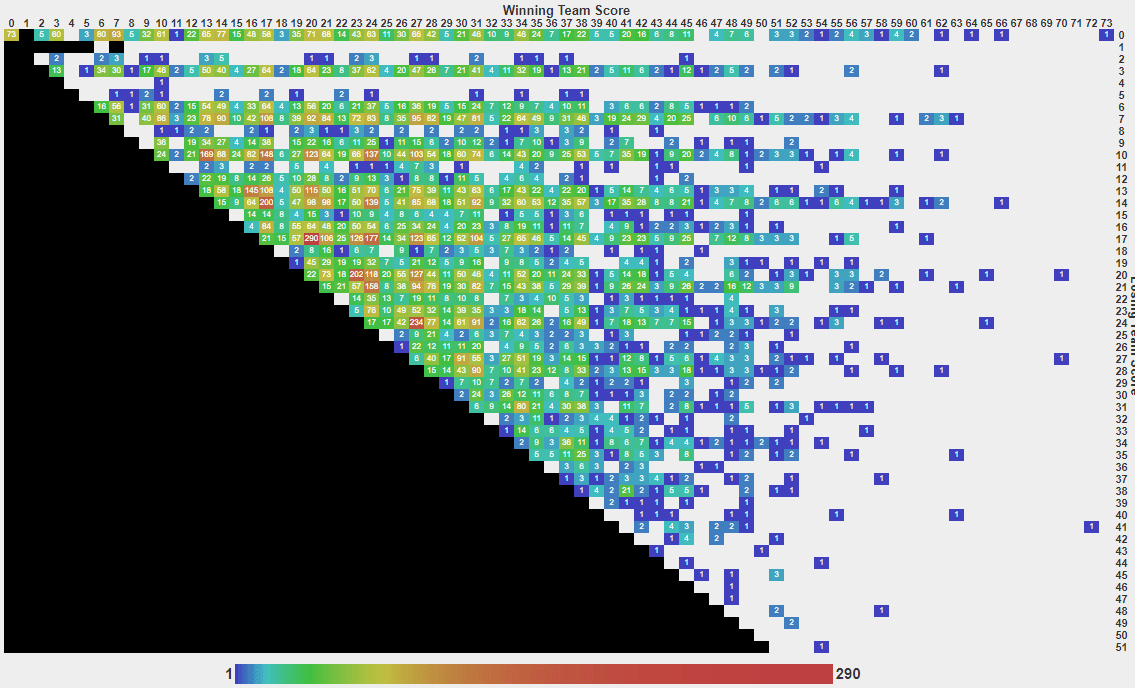
A scorigami is an NFL game that ends in a score the league has never seen before, and the internet celebrates each one as it happens. Plenty of research simulates NFL scores, but almost all of it targets who wins and by how much — nobody had modelled the score distribution itself well enough to say which scorigami was likely to fall next.
The approach
Started from a plain Poisson model of scoring and showed where it breaks: it ignores that scoring depends on game state and time remaining. Extended it to a non-stationary, state-dependent Poisson process fitted to extensive play-by-play data, then ran Monte Carlo simulations over roughly a million games per scenario to build an empirical distribution of final scores.
The result
The state-dependent model fits real NFL score data far more closely than the Poisson baseline, and the simulations forecast which unseen scores are most likely to occur next. Published at the 2024 Winter Simulation Conference.
From the paper